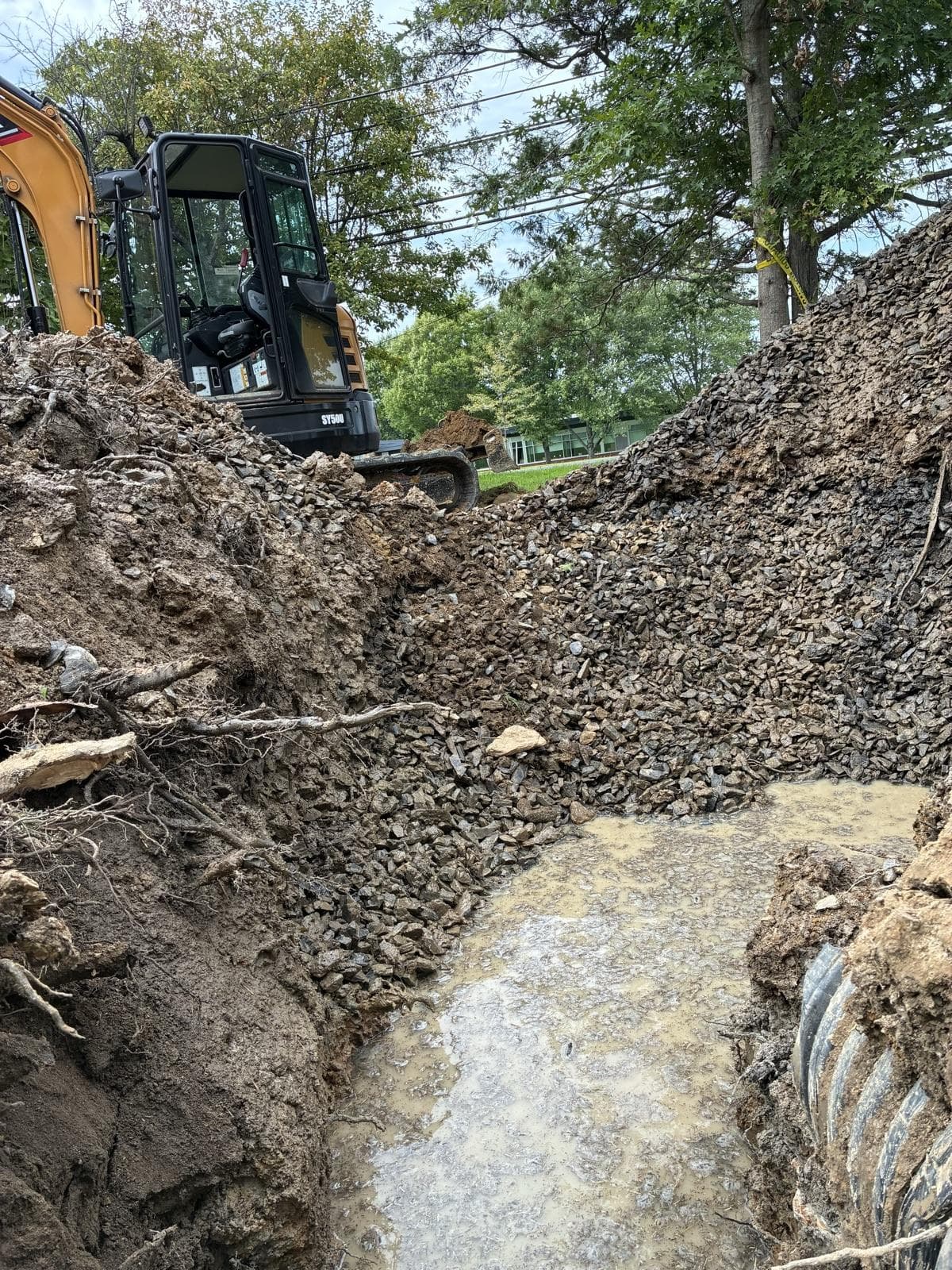
Subsurface Drainage
French Drain Installation
Get a Free Estimate
Fast, easy, no obligation. Firm written price after a site walk.
Princeton Excavation installs exterior French drains for yards that stay wet. We machine-trench the run, line it with filter fabric, bed perforated pipe in clean stone on a steady downhill pitch, and carry the water to a real outlet: daylight where the grade allows, a dry well where it does not. It is built for central New Jersey clay, not for the sandy soil in the textbook diagram.
What's in the trench
A French drain is a simple system with no optional parts. Leave one out and the drain has a short life.
Filter Fabric and Clean Stone
Geotextile fabric lines the trench and wraps the stone, keeping fine clay particles out. Washed stone, not crusher run, surrounds the pipe so water moves through it instead of sitting in packed fines.
Perforated Pipe on a Steady Pitch
We set the trench bottom so the perforated pipe falls continuously from the high end to the outlet. No bellies and no flat spots where water and silt collect.
An Outlet That Goes Somewhere
Collected water has to leave. We daylight the outlet downslope when the grade gives us the fall, or dig a dry well when it does not. A drain that dead-ends is just a buried puddle.
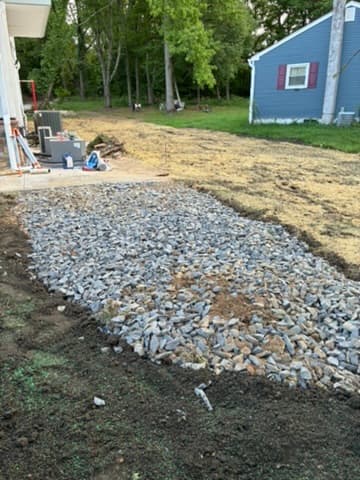
Why shortcut drains silt up
The usual failure is a trench with gravel dumped straight against the soil and no fabric. In clay, fine particles migrate into the stone over a few seasons and the trench packs solid. The fabric is not an upgrade.
Where we work
The other cause is volume. A seasonal high water table plus roof runoff concentrated at the downspouts puts more water into a Mercer County yard than clay can absorb. We keep downspouts on their own solid pipe instead of feeding them into the drain, and call in the NJ One Call (811) markout before trenching near any utility line.
Types of French drains and subsurface drainage
The right build depends on where the water comes from. Here are the kinds of work we do. We stay outside: yards, patios, and the ground around a house, never the basement slab.
A yard drain for a soggy lawn
This is the classic. A trench across or along the wet area collects water that is sitting in the top foot or two of soil and carries it out.
A curtain drain uphill of the house or patio
If water is sliding downhill through the soil toward your foundation or your patio, you cut it off before it arrives. A curtain drain sits across the slope, upslope of what you are protecting, and sends the water around it. Its location matters more than its length.
Homes just below a neighbor's higher lot are the usual candidates, a common setup on sloped lots, including drainage and excavation in Princeton.
An exterior drain along a foundation
Where water collects against the outside of a foundation wall, a deeper drain beside the footing can lower the water level there. It costs more because the trench is deep and access is tight, so we check first whether regrading or downspouts would do the job.
Downspout lines in solid pipe
Not strictly a French drain, but often the real fix. Roof water goes into closed pipe and travels well away from the house to its own outlet. It never touches the perforated line. Our trenching work covers these runs.
Daylight outlets versus dry wells
A daylight outlet is the end of the pipe at the surface of a downhill slope, where water simply flows out onto stable ground. It is the best option when the lot has fall. A dry well is a buried chamber of stone that holds water and lets it seep out, and it is what we use on flat lots. Our page on yard drainage solutions covers how we choose.
What goes in the trench
The parts cost little next to the labor of digging the trench, so there is no reason to skimp.
Fabric, stone, and pipe
A non-woven geotextile lines the trench so soil cannot wash into the stone. The stone is washed, clean 3/4 inch stone with no dust in it, because dust in the stone turns to a paste in clay. We deliver it ourselves; see our materials page.
The pipe is perforated and laid with the holes down or to the side, depending on the job, in a bed of stone with stone over it. Fabric wraps the package and overlaps on top. Past the collecting section, the run to the outlet is solid pipe.
Cleanouts and access
A cleanout is a capped riser that lets you flush the line. On long runs or runs with turns, we add them. They cost little now and spare you a dig later.
Princeton-area soil, rock, and water
The Princeton area sits on the Newark Basin, a band of sandstone, argillite, red shale, and diabase. That bedrock sets the soils your drain has to work in.
Clay on the Ridge
On the Princeton Ridge, Neshaminy and Legore soils form from diabase and carry a clayey subsoil. Readington soils, found over the shale and argillite, have moderately slow permeability. Water does not soak down quickly there. It sits, and in a wet season it shows up in your lawn.
Rock, boulders, and seasonal wetness
Diabase breaks down into boulder fields, and rock can be shallow. A trench that hits a boulder or ledge has to change depth or path, which moves the price. On the lower parts of the Ridge, clay over rocky soil can leave the ground seasonally wet, so water collects in places that look dry in August.
Why the outlet is the hard part
Digging the trench is the easy half. In slow soils a dry well drains slowly, so it has to be sized generously. Near Stony Brook or the Millstone River, the natural low spot may be a stream corridor with its own rules. We look for the outlet first and plan the trench backwards from it. In places like West Windsor and Lawrence Township, where lots can be flat, that often means a dry well, not a pipe to daylight.
Rules to know before digging
A good drain can still cause a neighbor problem, so a few ground rules apply.
Call 811 and keep water on your side
New Jersey law requires notice to NJ One Call by dialing 811 at least three full business days before you dig, weekends and holidays excluded. We call it in before every dig. As a plain good-practice rule, an outlet should never send water onto a neighbor's property, so we plan the discharge point inside your lot.
Stormwater and sensitive areas
A drain is not itself impervious surface. But Princeton's engineering rules require an on-site stormwater facility, such as a rain garden or grass swale, when a project adds more than 400 square feet of net new impervious area. A new patio or wider driveway can cross that line. Work in riparian areas, wetlands, or flood hazard areas needs approval from NJDEP. Other towns run their own reviews, so check with your municipality.
What a French drain costs
These are typical New Jersey market ranges, not our quote. Exterior yard French drains commonly price between $10 and $50 per linear foot. Deeper systems near a foundation run about $30 to $90 per foot. A run of 50 to 100 feet through a soggy side yard lands in the low-to-mid thousands.
Depth, rock, access, and outlet type move the number most. Full projects have a $3,000 minimum, and your price is firm and in writing after a free site walk. Smaller jobs can book the crew and machine by the half or full day.
How a job goes
From the first call to a clean handover
Site Walk
We walk the yard and follow the water to where it sits and where it could leave. You get a firm written price after the visit.
Markout and Layout
811 is called at least three full business days before digging. We stake the trench line and the outlet so you can see the plan first.
Trench and Grade
The mini excavator cuts the trench, and we check the bottom for a consistent fall toward the outlet.
Fabric, Stone, and Pipe
Fabric goes in with extra width to fold over the top, then a bed of clean stone, the perforated pipe, and more stone over it. Cleanouts go in where the run turns.
Outlet and Restoration
Fabric is folded over, topsoil goes back on, and the area is graded so water finds the drain.
Frequently Asked Questions
No. We build exterior and yard systems: the trench-and-pipe runs that intercept water outside before it reaches the house. Interior perimeter systems under a basement slab are waterproofing-contractor work, and we will say so if that is what your situation calls for.
It depends on the job. A drain catching surface water and shallow groundwater in a soggy lawn is often 12 to 24 inches deep. One cutting off water near a foundation goes deeper. Pitch and outlet elevation drive the numbers, and we work them out at the site visit.
Downhill, on purpose. If your lot has fall, we run the pipe out to daylight at grade, in a spot away from the house and the property line. On flat lots we can dig a dry well, a buried stone-filled chamber that holds the surge and lets it soak in slowly.
As a market range, not a quote: exterior yard drains commonly run $10 to $50 per linear foot, with deeper systems near a foundation at $30 to $90 per foot. We price your yard firm, in writing, after a site walk. Full projects have a $3,000 minimum; smaller jobs can book the crew and machine by the half or full day.
Service Areas
- PrincetonMercer County
- Hopewell TownshipMercer County
- Montgomery & SkillmanSomerset County
- West WindsorMercer County
- Lawrence TownshipMercer County
- PenningtonMercer County
- RobbinsvilleMercer County
- Hamilton TownshipMercer County
- PlainsboroMiddlesex County
- CranburyMiddlesex County
- South BrunswickMiddlesex County
- HillsboroughSomerset County
- EwingMercer County
Princeton, Hopewell Township, Montgomery & Skillman, and surrounding Mercer and Somerset County, NJ.
Wet yard every spring? Let's walk the trench line before the next rain.
Owner-operated and by appointment. Tell us about your project and we'll walk the site with you.
Request a Site Visit