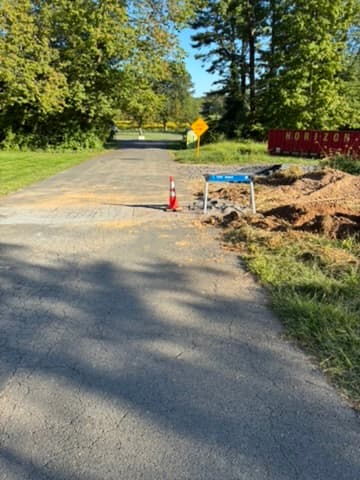
Driveway Earthwork
Driveway Excavation & Gravel Driveway Installation
Get a Free Estimate
Fast, easy, no obligation. Firm written price after a site walk.
Princeton Excavation digs out failed asphalt and gravel driveways and rebuilds what's underneath: geotextile fabric, dense-graded aggregate compacted in lifts, and a pitch that sheds water. We finish it as a gravel driveway or hand it off base-ready to your paving contractor.
How the rebuild works
A driveway fails from the bottom, so that's where we work. We call in the NJ One Call 811 markout before any cutting starts.
Full-Depth Dig-Out
We cut out the failed surface and the soft subgrade under it, not just the top few inches. Spoils get loaded into our 7-yard dump truck and hauled off the same day.
A Base Built in Lifts
Geotextile fabric over the subgrade, then dense-graded aggregate placed and compacted in lifts. We check depth and slope along the whole run, not just at the ends.
Pitch That Sheds Water
We set crown and pitch so rain runs off the driveway instead of into your garage or down the middle of it. Standing water is what kills driveways.
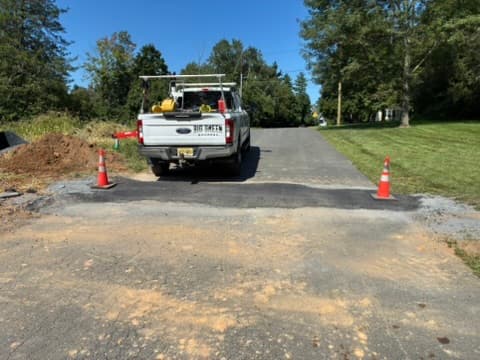
Why driveways fail early
Cracked asphalt and rutted gravel are symptoms. The cause is almost always underneath: a thin base, no fabric, or subgrade that was never compacted. Resurfacing over a bad base buys a couple of years. Rebuilding the base fixes it. That's the part we do, and our 5-6 ton excavator and dump truck are sized for a residential drive.
Where we work
From there you have two finishes. We build gravel driveways as a complete product, with compacted quarry process over the base, graded to shed water. Or, if you're paving, we hand your asphalt contractor a compacted, graded base ready for the paver. We also widen tight approaches and rebuild aprons where the driveway meets the road.
Kinds of driveway excavation work
Most calls fall into a few buckets. We do not pave asphalt, so anything that ends in a black surface gets handed to a paving contractor once the base is done.
Dig out and rebuild a failed driveway
This is the big one. The surface is broken up, the soft subgrade is removed, and the whole thing is rebuilt with fabric and compacted stone.
A new gravel driveway on raw ground
Topsoil comes off, the bed is cut, fabric goes down, and the base is built with a crowned top course. For a long run through the country, like the excavation work we do in Hopewell Township, the length is mostly about hauling stone and keeping the grade consistent.
Widening, parking pads, and turnarounds
We cut the extension in, match the depth of the old base, and blend the grades.
Aprons and the connection to the street
Where the drive meets the road is the first spot to crumble, because it takes the weight of every turning wheel. We rebuild the apron base. Work that cuts into the curb, sidewalk, or roadway needs a permit in most towns, covered below.
Base prep for your paving contractor
We bring the base to grade, compact it, and your paver takes it from there.
What goes under a driveway that lasts
From the bottom up: subgrade, a fabric separator, a dense-graded aggregate base, then the surface. If the lower layers are wrong, no top layer saves you.
Depth is set by the soil and by what parks on it. As a working rule, a gravel driveway for cars wants roughly 6 to 8 inches of compacted dense-graded aggregate over geotextile fabric, and 10 to 12 inches where the subsoil is soft clay or the drive sees trucks, trailers, or an oil delivery. Under asphalt, the stone base commonly runs 4 to 8 inches below the paving itself.
Fabric, aggregate, and compaction
Geotextile fabric keeps the stone from pressing down into wet soil and the mud from pumping up into the stone. On top of it goes dense-graded aggregate like QP or crusher run. It has fines mixed in, so it locks together when compacted. Clean stone does not lock up like that, which is why we do not use it as a driving surface. We place the aggregate in lifts and compact each one, so the bottom of the base is as tight as the top.
A crowned center and a steady pitch move rain off the surface fast. Flat is the enemy.
Where clean stone belongs
Three-quarter inch clean stone is open and drains freely, so it earns its spot in a drain run along the edge of a drive or at a low point, not in the driving surface. If water is the real issue, a short trench for a drain line beside the driveway may do more good than more stone on top.
Clay, rock, and frost around Princeton
The Princeton area sits on the sandstone, argillite, shale, and diabase of the Newark Basin, and what comes out of the ground changes from one road to the next.
Clay that holds water
Soils formed from shale and argillite, and the reddish subsoil over the diabase on the Princeton Ridge, tend to be clayey. Clay drains slowly. It softens in a wet spring, and that is when ruts show up. That is the main reason fabric and a deeper base matter here.
Shallow rock and boulders
Diabase, the dark rock of the Ridge, weathers into boulder fields, and the Lockatong argillite runs through Princeton itself. A dig-out can hit rock a foot down on one side of a lot and clean soil on the other. Rock changes the time and sometimes the plan, and we tell you the moment we hit it. For work in Princeton itself, see our Princeton excavation page.
Frost and why it matters
Frost depth in this part of New Jersey is 36 inches, the number house footings are built below. A driveway is not a footing, and no 36 inch base is required for one. The point is simpler: water in the soil freezes, expands, and lifts a driveway unevenly, then leaves a soft spot when it thaws. A base that drains well and a surface that sheds water give the soil less water to freeze.
Permits and rules to check before you dig
Rules vary by town, so treat this as a starting list and not legal advice. Your municipality has the final say.
811 before any digging
New Jersey law requires a call to 811 at least three full business days before digging. Weekends and holidays do not count. We call it in on every job.
Stormwater and impervious area
Stone is not exempt. In Princeton, an improvement to a one or two family home that adds more than 400 square feet of net new impervious area, stone driveways included, needs an on-site stormwater facility and approval from Engineering. A new parking pad 10 feet wide and 41 feet long already crosses that line. Other towns run their own reviews, so check with yours; our page on excavation in Montgomery and Skillman covers that area.
Work in the street and soil disturbance
Cutting into the curb, sidewalk, or roadway for an apron generally needs a right-of-way excavation permit. In Princeton that comes from Engineering, and they want 48 hours of notice before the work and before final grading inspection. Separately, disturbing more than 5,000 square feet of soil triggers soil erosion and sediment control plan review through your county's Soil Conservation District.
What driveway excavation costs
Typical New Jersey ranges, for budgeting only: removing an old driveway and prepping the subgrade usually runs $1,000 to $2,500. A new gravel driveway installed over a proper base is commonly $4 to $10 per square foot, roughly $4,000 to $10,000 for a 100-foot by 10-foot drive. Full projects have a $3,000 minimum; smaller jobs can book the crew and machine by the half or full day.
The spread comes from what you can see on a site walk: haul-off volume, soft soil that needs extra stone, the length and slope of the run, and truck access. We give you one firm written price after we measure it.
How a job goes
From the first call to a clean handover
Site Walk and Measure
We walk the drive with you, note where water sits, and measure the run. You get a firm written price after the visit.
Markout and Permits
811 gets called at least three full business days ahead. If the job touches the street or crosses a town's impervious limit, we flag it so the permit is in hand before a bucket goes in the ground.
Dig-Out
The old surface and the soft subgrade come out and ride away in the dump truck. We keep digging until we hit firm ground, not until we hit a number.
Fabric, Stone, Compaction
Geotextile goes down, then dense-graded aggregate in compacted lifts, shaped with a crown and a pitch.
Handover
Gravel drives are done and ready to use. If you're paving, we tell your paving contractor the base is ready and they can schedule right behind us.
Frequently Asked Questions
No. We do the excavation and base work, then coordinate directly with your paving contractor so they pave right behind us. Gravel driveways we build start to finish ourselves.
Compacted subgrade, geotextile fabric to keep the stone from pumping into the soil, then dense-graded aggregate such as crusher run or QP, placed and compacted in lifts rather than dumped in one pass.
Yes. We cut the extension in, build the base to match the existing depth, and tie the grades together so the new section doesn't settle away from the old one.
As a market range, not a quote: digging out and hauling off an existing driveway and prepping the subgrade commonly runs $1,000 to $2,500, and a finished gravel driveway typically lands at $4 to $10 per square foot installed. We price it firm, in writing, after a site visit. Full projects have a $3,000 minimum; smaller jobs can book the crew and machine by the half or full day.
Service Areas
- PrincetonMercer County
- Hopewell TownshipMercer County
- Montgomery & SkillmanSomerset County
- West WindsorMercer County
- Lawrence TownshipMercer County
- PenningtonMercer County
- RobbinsvilleMercer County
- Hamilton TownshipMercer County
- PlainsboroMiddlesex County
- CranburyMiddlesex County
- South BrunswickMiddlesex County
- HillsboroughSomerset County
- EwingMercer County
Princeton, Hopewell Township, Montgomery & Skillman, and surrounding Mercer and Somerset County, NJ.
Driveway past saving? Let's look at what's under it.
Owner-operated and by appointment. Tell us about your project and we'll walk the site with you.
Request a Site Visit